
What is a proportion?
A proportion is an equation that says two ratios are equal. If a ratio compares a to b and a second ratio compares c to d, the statement that both describe the same relationship is written as:

Extremes and means
In the form a : b = c : d, the outer terms a and d are called the extremes and the inner terms b and c are the means. The key property of every true proportion is that the product of the extremes equals the product of the means: a × d = b × c. This is the rule the calculator uses, and it is why proportions are one of the most useful tools for finding an unknown quantity when three other quantities are known.
How to solve a proportion step by step
The four steps
- Write the proportion as two equal fractions and put a letter (usually x) where the value is missing.
- Cross-multiply. Multiply the numerator of each fraction by the denominator of the other: a × d = b × c.
- Isolate the unknown. Divide both sides by the number that sits next to x.
- Check your answer. Divide both fractions – they should give the same decimal.
Worked example: 3/4 = x/12
Example: solve 3 / 4 = x / 12. Cross-multiplying gives 3 × 12 = 4 × x, so 36 = 4x and therefore x = 9. Check: 3 ÷ 4 = 0.75 and 9 ÷ 12 = 0.75. The calculator above shows exactly this working for any numbers you enter.
Proportion formulas
Formula for each unknown
Rearranging a ÷ b = c ÷ d gives one formula for each unknown. Use them to double-check the calculator or to solve by hand:
| Missing value | Direct proportion (a ÷ b = c ÷ d) | Inverse proportion (a × b = c × d) |
|---|---|---|
| a | a = (b × c) ÷ d | a = (c × d) ÷ b |
| b | b = (a × d) ÷ c | b = (c × d) ÷ a |
| c | c = (a × d) ÷ b | c = (a × b) ÷ d |
| d | d = (b × c) ÷ a | d = (a × b) ÷ c |
Direct vs inverse proportion
Two quantities are in direct proportion when they rise and fall together at the same rate – double one and the other doubles. They are in inverse proportion when one goes up as the other goes down so that their product stays constant.
Direct and inverse proportion compared
| Direct proportion | Inverse proportion | |
|---|---|---|
| Rule | a ÷ b = c ÷ d (the ratio is constant) | a × b = c × d (the product is constant) |
| Behaviour | More of one → more of the other | More of one → less of the other |
| Typical examples | Price vs quantity, distance vs time at fixed speed, recipe ingredients vs servings | Workers vs days to finish a job, speed vs travel time for a fixed distance |
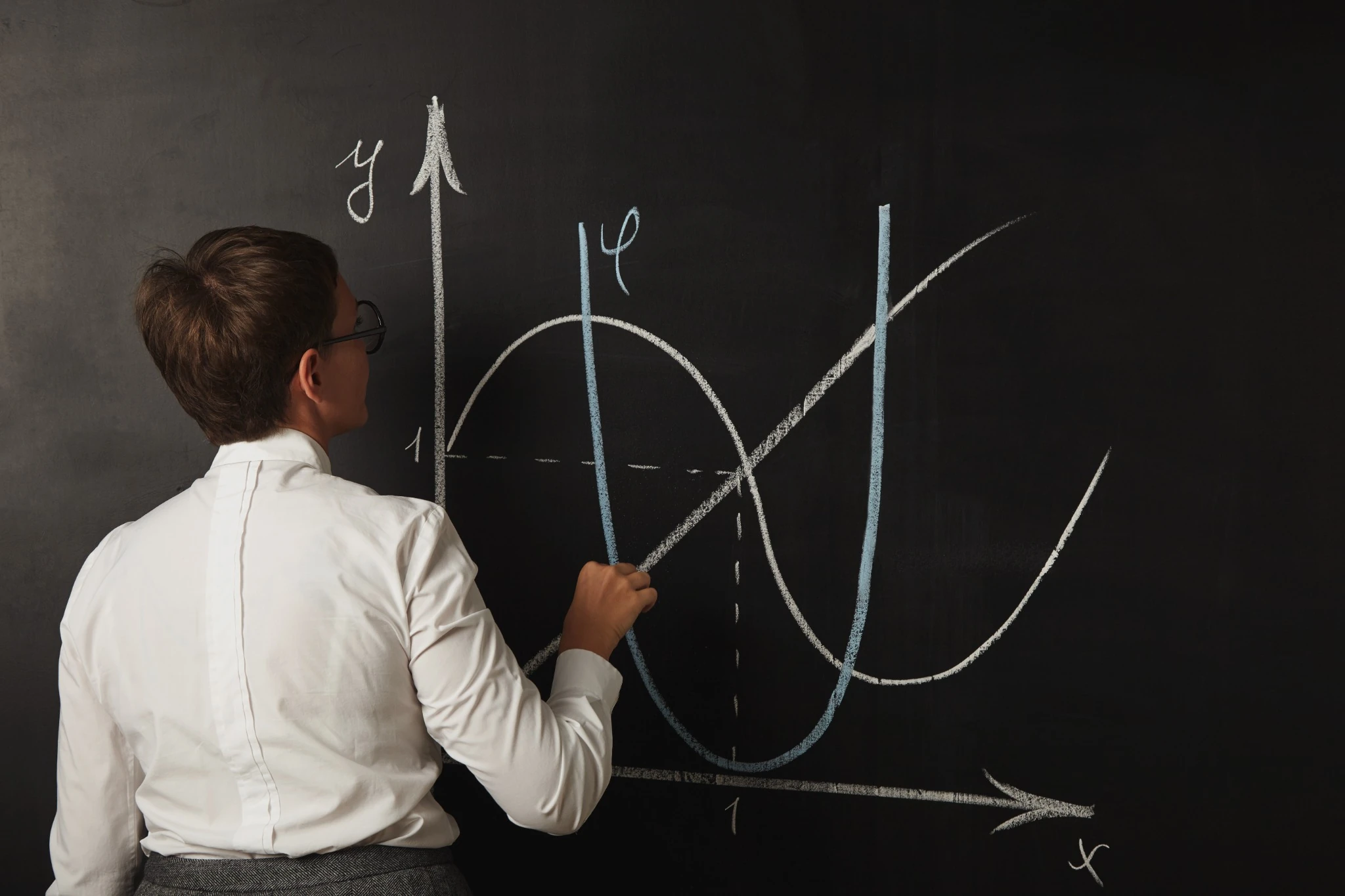
| Graph | Straight line through the origin | Curve (hyperbola) |
Switching between the two types
Use the Type of proportion menu in the calculator to switch between the two.
What is a continuous proportion?
A continuous proportion is a sequence of equal ratios in which the middle terms are shared, such as a : b = b : c. The shared term is the mean proportional, and it satisfies b² = a × c. For example, if 4 : 6 = 6 : 9, then 6 is the mean proportional because 6² = 4 × 9 = 36. This is a related proportion concept; use the main solver for a standard two-ratio equation with one unknown.
Worked examples
Recipes and maps
1. Scaling a recipe. A cake for 4 servings needs 3 cups of flour. How much flour for 10 servings?
3 ÷ 4 = x ÷ 10 → x = 3 × 10 ÷ 4
x = 7.5 cups
2. Reading a map. On a map, 1 cm represents 25 km. Two towns are 7.2 cm apart on the map. What is the real distance?
1 ÷ 25 = 7.2 ÷ x → x = 25 × 7.2 ÷ 1
x = 180 km
Shopping and inverse proportion
3. Shopping. 5 notebooks cost $12.50. What do 8 notebooks cost at the same price each?
5 ÷ 12.50 = 8 ÷ x → x = 12.50 × 8 ÷ 5
x = $20.00
4. Inverse proportion. 6 workers need 12 days to finish a job. How long will 9 workers take, working at the same pace?
6 × 12 = 9 × x → x = 72 ÷ 9
x = 8 days
Resizing an image
5. Resizing an image. A 1920 × 1080 image must be 1280 pixels wide. What height keeps the proportions?
1920 ÷ 1080 = 1280 ÷ x → x = 1080 × 1280 ÷ 1920
x = 720 px (a 16:9 image)
Special calculators built into this page
Many everyday questions are proportions in disguise. Besides the main solver, this page includes five ready-made calculators that set the proportion up for you, using US units such as ounces, pounds, gallons, feet and inches.
Percent proportion: part ÷ whole = percent ÷ 100
A percentage is simply a ratio out of 100, so every percent problem fits one proportion. Put the part over the whole on the left and the percent over 100 on the right, then cross-multiply. To find 20% of $85: part ÷ 85 = 20 ÷ 100, so part = 85 × 20 ÷ 100 = $17, and a 20%-off price is $85 − $17 = $68. The same setup answers “what percent is 45 of 180?” (25%) and “30 is 12.5% of what number?” (240). Open the percent proportion calculator →
Unit price: price ÷ quantity
The unit price is what you pay for one unit – one ounce, one pound, one fluid ounce, one roll. To compare different package sizes, convert them to the same unit first. For example, a 16 oz jar at $4.99 costs $0.3119 per ounce, while a 1.5 lb jar at $7.49 holds 24 oz and costs $0.3121 per ounce – practically the same, even though the second jar looks like a bigger bargain. The calculator converts weight, volume, count and length units for you and ranks up to five products. Open the unit price calculator →
2-stroke fuel mix ratio (gas : oil)
A ratio such as 50:1 means 50 parts gasoline to 1 part oil. One US gallon is 128 fluid ounces, so the oil needed for one gallon of gasoline is 128 ÷ 50 = 2.56 fl oz. This chart shows common ratios:
| Gas : oil ratio | Oil per 1 gal of gasoline | in mL | Oil per 5 gal |
|---|---|---|---|
| 16:1 | 8 fl oz | 236.6 mL | 40 fl oz |
| 24:1 | 5.33 fl oz | 157.7 mL | 26.7 fl oz |
| 32:1 | 4 fl oz | 118.3 mL | 20 fl oz |
| 40:1 | 3.2 fl oz | 94.6 mL | 16 fl oz |
| 50:1 | 2.56 fl oz | 75.7 mL | 12.8 fl oz |
| 100:1 | 1.28 fl oz | 37.9 mL | 6.4 fl oz |
These figures assume the gallon refers to the gasoline itself. If your container size is the final mixture, switch the “Amount refers to” menu in the calculator. Always follow the ratio printed in your engine or oil manual. Open the fuel & dilution mix calculator →
Dilution ratios for concentrates
Cleaners, lawn products and many chemicals are sold as concentrates. A 1:10 label can mean “1 part concentrate + 10 parts water” (11 parts in total) or “1 part concentrate in 10 parts total”. The calculator lets you choose the reading that matches your label and then gives the exact concentrate and water volumes for any batch size.
Blueprint, map and model scale
A scale is a proportion between a drawing and reality. An architectural scale of ¼″ = 1′-0″ means every quarter inch on the plan is one real foot – a ratio of 1:48. Multiply the measured length (in inches) by the scale ratio to get the real length in inches, then divide by 12 for feet.
| Architectural scale | Ratio | 1″ on the drawing equals |
|---|---|---|
| ⅛″ = 1′-0″ | 1:96 | 8′-0″ |
| ¼″ = 1′-0″ | 1:48 | 4′-0″ |
| ⅜″ = 1′-0″ | 1:32 | 2′-8″ |
| ½″ = 1′-0″ | 1:24 | 2′-0″ |
| ¾″ = 1′-0″ | 1:16 | 1′-4″ |
| 1″ = 1′-0″ | 1:12 | 1′-0″ |
| 1½″ = 1′-0″ | 1:8 | 0′-8″ |
| 3″ = 1′-0″ | 1:4 | 0′-4″ |
Open the blueprint & model scale calculator →
Similar triangles and scale factor
Two triangles are similar when they have the same shape: their corresponding sides are in proportion. The ratio between them is the scale factor k. Perimeters grow by k, but areas grow by k². If a 3-4-5 triangle is enlarged so its first side is 6, then k = 2, the other sides become 8 and 10, and the area is four times larger. The same idea lets you measure a tree with a shadow: a 6-foot person casting a 4-foot shadow means a tree casting a 30-foot shadow is 6 ÷ 4 = x ÷ 30 → 45 feet tall. Open the similar triangles calculator →
Ratio, recipe, split and aspect-ratio calculators
Four more tools on this page apply the same proportion idea to ratios, shopping lists, shared costs and screen sizes.
Ratio simplifier: divide every term by the greatest common divisor
To simplify a ratio, divide every term by their greatest common divisor (GCD). The ratio 12 : 18 : 30 has a GCD of 6, so it simplifies to 2 : 3 : 5. Two ratios are equivalent when they reduce to the same simplest form, and each part can also be shown as a percentage of the total. Open the ratio simplifier →
Recipe and list scaler: multiply by the scale factor
The scale factor is the new amount divided by the original amount. A recipe for 4 people that must serve 6 has a factor of 6 ÷ 4 = 1.5, so 2 cups of flour become 3 cups and ¾ cup of milk becomes 1⅛ cups. The same method scales paint, concrete or any materials list. Open the recipe and list scaler →
Ratio splitter: total ÷ sum of parts × each part
To share a total in a given ratio, add the parts, divide the total by that sum to find one part, then multiply by each part. Splitting $300 in the ratio 2 : 3 gives 5 parts of $60, so the shares are $120 and $180. This works for dividing costs, profits, inheritances or ingredients. Open the ratio splitter →
Aspect ratio resizer: new height = new width × (old height ÷ old width)
An aspect ratio such as 16:9 compares width to height. To keep the shape when resizing, scale both sides by the same factor. A 1920 × 1080 image resized to 1280 pixels wide must be 1280 × 1080 ÷ 1920 = 720 pixels high. Open the aspect ratio resizer →
Everyday uses of proportions

- Cooking and baking – scale a recipe up or down without guessing.
- Maps, models and blueprints – convert between drawing size and real size.
- Shopping and budgeting – compare unit prices and work out the cost of a different quantity.
- Construction and DIY – mix paint, concrete or cleaning solutions in the right ratio.
- Health and fitness – adjust doses or macro splits by body weight (always confirm medical doses with a professional).
- Design and video – keep images, screens and videos undistorted when resizing.
- Money and business – split profit, rent or bills fairly according to agreed shares.
- Science – dilutions, conversions and scaling experiments.
Common mistakes to avoid
- Mixing up the order. Keep the same kind of quantity in the same position on both sides (cups over servings on the left means cups over servings on the right).
- Using different units. Convert first – do not compare minutes with hours or centimetres with metres in the same ratio.
- Treating an inverse relationship as direct. If more of one thing means less of the other, switch to inverse mode.
- Dividing by zero. The bottom term of a fraction can never be 0, so b and d must not be zero in a direct proportion.
- Rounding too early. Keep exact fractions or extra decimals until the final answer – this calculator does that for you.
How to Set Up Proportion Word Problems
The most important step in a proportion word problem is matching the quantities in the correct order. Put the same type of measurement in the same position in both ratios. For example, if cups of flour are in the numerator on the left, cups of flour must also be in the numerator on the right.
Example: Scaling a cookie recipe
A recipe uses 3 cups of flour to make 24 cookies. How much flour is needed for 40 cookies?
Cross-multiply: 24 × x = 3 × 40 = 120. Divide by 24 to get x = 5 cups.
Check: 3/24 and 5/40 both simplify to 1/8, so the ratios are equivalent.
Keep units in matching positions
- Correct setup: cups ÷ cookies = cups ÷ cookies.
- Incorrect setup: cups ÷ cookies = cookies ÷ cups. This reverses the relationship and answers a different question.
- Convert units first: Change measurements to the same unit before comparing them, such as minutes to hours or centimetres to metres.
Before accepting an answer, ask whether it is reasonable. If a larger batch needs more ingredients, an answer that uses less flour is a sign that the proportion may have been arranged incorrectly.
Worked Proportion Examples: Find the Missing Value
Use cross multiplication to solve each proportion. The examples below cover recipe scaling, equivalent ratios, map distances, prices, measurements and percentages.
| Proportion | Cross products | Missing value |
|---|---|---|
| 3/24 = x/40 | 24 × x = 3 × 40 = 120 | x = 5 |
| 8/56 = x/49 | 56 × x = 8 × 49 = 392 | x = 7 |
| 3/4 = x/20 | 4 × x = 3 × 20 = 60 | x = 15 |
| 2/5 = x/15 | 5 × x = 2 × 15 = 30 | x = 6 |
| x/12 = 3/4 | 4 × x = 12 × 3 = 36 | x = 9 |
| 1/50 = 7/x | 1 × x = 50 × 7 = 350 | x = 350 |
| 4/6 = 10/x | 4 × x = 6 × 10 = 60 | x = 15 |
| 5/8 = 20/x | 5 × x = 8 × 20 = 160 | x = 32 |
| 6/4 = x/22 | 4 × x = 6 × 22 = 132 | x = 33 |
| 15/100 = x/80 | 100 × x = 15 × 80 = 1,200 | x = 12 |
| 3/4 = 5/x | 3 × x = 4 × 5 = 20 | x = 20/3 ≈ 6.67 |
Two ways to solve the same proportion
Unit rate: If 3 cups of flour make 24 cookies, then 24 ÷ 3 = 8 cookies per cup. For 40 cookies, calculate 40 ÷ 8 = 5 cups.
Scale factor: The batch grows from 24 to 40 cookies, so the scale factor is 40 ÷ 24 = 5/3. Multiply the original 3 cups by 5/3 to get 5 cups.
Both methods give the same result as cross multiplication. Use the method that makes the relationship easiest to understand, and keep the units consistent throughout the calculation.
Proportion Definition and Math Reference
A proportion is an equation of the form a/b = c/d, where the denominators b and d are not zero. It states that two ratios or rates are equal. The cross products are therefore equal: a × d = b × c.
For a textbook explanation of the definition of a proportion, cross products, and applications involving proportions, see OpenStax Prealgebra 2e, Section 6.5: Solve Proportions and Their Applications.
Use this reference alongside the examples above, then try your own values in the proportion calculator. For percentage questions, you can also open the percent proportion calculator, or use the ratio simplifier to reduce and compare ratios.
Frequently asked questions
Proportion basics
What is a proportion in math?
A proportion is an equation stating that two ratios are equal, written a/b = c/d or a : b = c : d. For example, 3/4 = 9/12 is a proportion because both fractions equal 0.75.
How do you solve a proportion?
Cross-multiply and divide. Multiply the numerator of each fraction by the denominator of the other (a × d = b × c), then divide both sides by the number next to the unknown. The calculator above performs these steps and shows them.
What is the cross-multiplication rule?
In any true proportion a/b = c/d, the product of the extremes (a × d) equals the product of the means (b × c). If the two products are different, the ratios are not proportional.
What is the formula for a proportion?
The proportion formula is a/b = c/d. Cross-multiplying gives a × d = b × c, so each missing value is found by multiplying the two numbers on the diagonal and dividing by the number opposite the unknown: a = (b × c) ÷ d, b = (a × d) ÷ c, c = (a × d) ÷ b and d = (b × c) ÷ a.
What is the difference between direct and inverse proportion?
In a direct proportion the ratio of the two quantities stays constant, so both increase or decrease together (a/b = c/d). In an inverse proportion their product stays constant, so one goes up when the other goes down (a × b = c × d).
How do I check whether two ratios are proportional?
Enter all four values and leave no box empty. The calculator compares the cross products and tells you whether the ratios are proportional. If they are not, it shows which single value you could change to make the proportion true.
Can a proportion contain zero or negative numbers?
The denominators b and d of a direct proportion can never be zero. A numerator can be zero, and negative values are mathematically valid, for example -2/4 = 3/-6. For real-world quantities such as prices and lengths you will normally use positive numbers.
Percent, price, ratios and recipes
How do I calculate a percent using a proportion?
Use the percent proportion part ÷ whole = percent ÷ 100. Fill in the two numbers you know, cross-multiply and divide. For example, 20% of 85: part ÷ 85 = 20 ÷ 100, so part = 85 × 20 ÷ 100 = 17.
How do I calculate unit price?
Divide the price by the quantity: unit price = price ÷ size. To compare products sold in different sizes, convert them to the same unit first (for example, price per ounce). The product with the lowest unit price is the cheapest per unit.
How do I simplify a ratio?
Divide every term of the ratio by their greatest common divisor (GCD). For 12 : 18 : 30 the GCD is 6, so the simplest form is 2 : 3 : 5. Two ratios are equivalent when they reduce to the same simplest form.
How do I scale a recipe with a proportion?
Divide the new number of servings by the original number to get a scale factor, then multiply every ingredient by it. The Scale a recipe tab does this for a whole list at once and can display kitchen-friendly fractions such as ½ and ¾.
How do I split an amount by a ratio?
Add the parts of the ratio, divide the total by that sum to get the value of one part, then multiply by each part. To split $300 in the ratio 2 : 3, there are 5 parts, one part is $60, and the shares are $120 and $180.
Mixes, scales, triangles and image sizes
How much oil do I add for a 50:1 fuel mix?
A 50:1 ratio means 50 parts gasoline to 1 part oil. Since a US gallon is 128 fluid ounces, add 128 ÷ 50 = 2.56 fl oz (about 76 mL) of 2-stroke oil per gallon of gasoline. Always follow the ratio recommended in your engine or oil manual.
What does a 1:10 dilution ratio mean?
It depends on the label. Many products mean 1 part concentrate plus 10 parts water (11 parts in total), while others mean 1 part concentrate in 10 parts of finished solution. The mix calculator lets you choose either meaning.
How do I read an architectural scale like 1/4 inch = 1 foot?
At ¼″ = 1′-0″ each quarter inch on the drawing equals one real foot, so the ratio is 1:48. Multiply the measured length in inches by 48 to get the real length in inches, then divide by 12 for feet.
How do I find a missing side of similar triangles?
Find the scale factor from one pair of corresponding sides (side of triangle 2 ÷ side of triangle 1), then multiply or divide the known side of the other triangle by that factor. Areas change by the square of the scale factor.
How do I resize an image and keep the aspect ratio?
Use new height = new width × (original height ÷ original width). For a 1920 × 1080 image resized to 1280 pixels wide, the height is 1280 × 1080 ÷ 1920 = 720 pixels, so the 16:9 shape is preserved.
Using the calculator, PDF and privacy
Can I enter fractions and decimals in the calculator?
Yes. You can type whole numbers, decimals such as 2.5, fractions such as 3/4, mixed numbers such as 1 1/2 and scientific notation such as 2e3. The proportion, percent, ratio and triangle tools use exact fractions internally, so there are no hidden rounding errors.
How do I download or print my result as a PDF?
After you calculate, click Download PDF under the result. The PDF is created in your browser and downloads straight away, with the answer and the step-by-step working printed on the page. Click Print instead if you want a paper copy. Nothing is uploaded.
Is the proportion calculator free and private?
Yes. It is free to use without sign-up, and all calculations happen in your browser. Your numbers are not uploaded. Recent calculations are stored only in your own browser and can be cleared at any time.